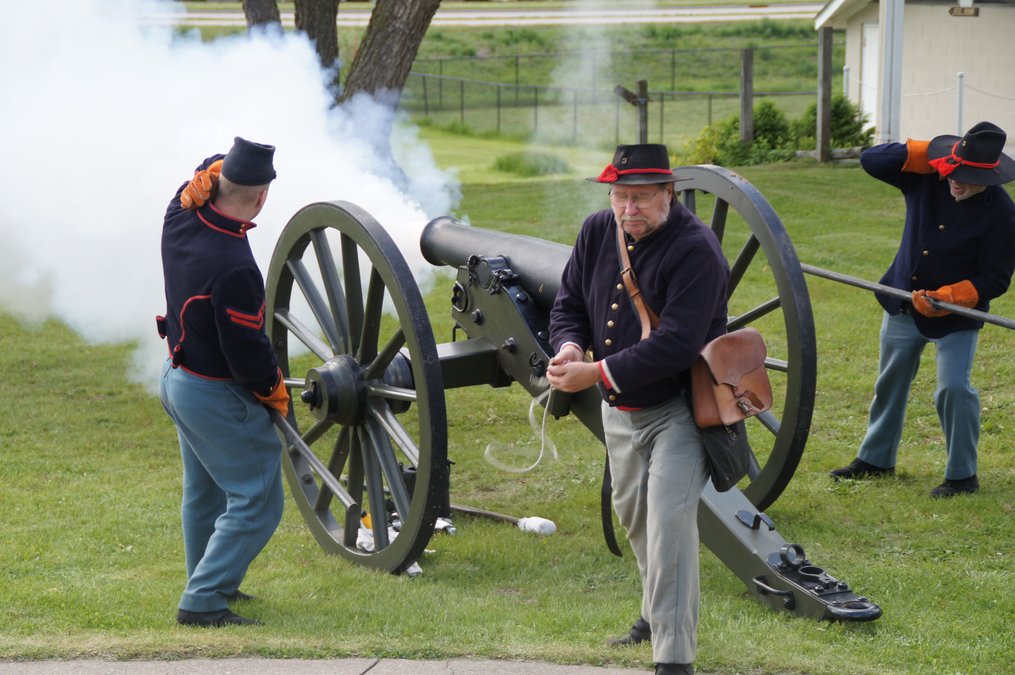
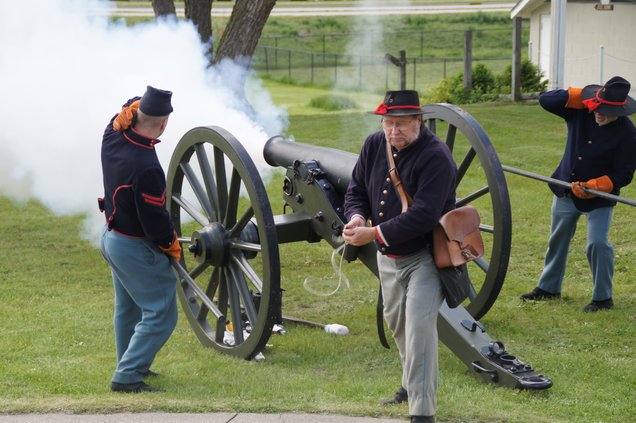
The Pattern 1827 Cannon owned by the PdC Historical Society is one of two in the world that still exists and the ONLY one in the world that still fires! John Richard, cannon expert who over saw the Pattern 1827 cannon restoration, made the discovery this summer. This winter the cannon will be placed on the national cannon registry.
The Pattern 1827 Cannon has been on the campus of Fort Crawford or in Prairie du Chien its entire time of service. The nine-pound field gun was made by the Alexander McClurg/ Fort Pitt Foundry in Pittsburg, Pennsylvania, later known as the Fort Pitt Works. The cannon is marked on the trunnion: McC&Co. and on the barrel are marks No76 and IB. It can be concluded that out of the 98 cannons ordered by the U.S., in 1827, it was the seventh-sixth cannon cast by McClurg & Co. and was cast for the United States Indian Bureau.
The first Fort Crawford was built on St. Feriole Island, Prairie du Chien in 1816. A wooden structure, age, and numerous years of flooding caused the barracks to be uninhabitable. The fort was abandoned in 1826 and the soldiers and ordnance (muskets, cannons, and ammunition) were transferred to Fort Snelling, MN. The Winnebago Uprising of 1827, in which the residents of Prairie du Chien were attacked, made the U.S. War Department reassess their decision to remove the fort. Accordingly, it was determined to maintain a garrison at Prairie du Chien. This time the fort would be located on high ground.
Construction on the second Fort Crawford began in the spring of 1829 and within a year the soldiers were housed in the barracks. With the investment of the new fort, the U.S. government shipped new ordnance to supply the garrison. There was unrest in the Mississippi Valley, the Ojibwa and Sioux in confrontation to the north, and the Sac restless on the lands along the west bank of the river. Fort Crawford had to be able to protect itself.
In 1829, the Pattern 1827 nine-pound cannon would have been the most up-to-date field gun available. Therefore it was likely to be sent to the new Fort Crawford, considered to be according to an Army government inspector, to be the “the most important post on the Mississippi . . .” Over the next twenty years troops continued to be stationed at Fort Crawford and participated in a number of duties and wars. Soldiers only occupied the Fort intermittently after 1849. Thinking that the removal was permanent Lieutenant R. W. Foote with a small detail of soldiers remained behind to dispose of government property and stores.
The cannon passed on to the residents of Prairie du Chien. Events reported in the newspaper state that the cannon was fired at the Prairie du Chien 4th of July celebrations. When the Civil War broke out in April 1861, Fort Crawford was used as a location to recruit and train men for the Union forces. At first the Prairie du Chien Guards created an armory in one of the Fort Crawford buildings and held drills and meetings on the grounds. The Prairie du Chien Greys and then the Prairie Du Chien Volunteers soon joined them. The Greys and Volunteers held drills every Tuesday and Saturday. The Courier newspaper reported “Their cannon will be fired as a signal for the Company to turn out.”
The lack of any other cannon with a history of connecting it to Prairie du Chien allows the conclusion to be drawn that the Pattern 1827 Cannon owned by the PdC Historical Society is the cannon used to call the Prairie du Chien Greys and Volunteers to arms in 1861. The men from Prairie du Chien and Crawford County enlisted at Fort Crawford and served in the 6th, 8th, and 31st Wisconsin Volunteer Infantry.
In August 1864, the U.S. War Department opened the Swift Army Hospital at Prairie du Chien. In a ten and a half month period over 1,500 Union soldiers received care at the hospital located in the old Brisbois Hotel (now the location of the Prairie du Chien Correctional Institution) and Fort Crawford. After a year of caring for the sick and wounded, the hospital closed in September of 1865. An exhibit on the Fort Crawford on the Civil War and theSwift Army Hospital can be viewed at the Fort Crawford Museum.
In 1867, the U.S. Government sold the Fort Crawford grounds and property. The cannon passed though several owners until it was returned to the Fort Crawford property in 1970. The Pattern 1827 Cannon is on display at the PdC Historical Society.
On October 26 at 5 pm the Historical Society will hold the ceremonial lowering of the Colors to close for the season. To honor the military tradition of Fort Crawford, the Prairie du Chien honor guard and bugle player will lower the flag and there will be a firing of the cannon. Please join the Historical Society at the Fort Crawford Museum, 717 S. Beaumont, for this time honored tradition.