In the summer months, there’s nothing quite as sweet as the taste of honey.
This past month, the Ridge and Valley Beekeepers Club ventured out to rural Steuben, joining Lyle and Ann Wanless on their property for a member’s potluck. The club typically meets in the Gays Mills Community Commerce Center every few months, but the potluck is a unique opportunity for the group to see something a bit different: a flow hive.
Lyle said that they inherited two regular hives and a flow hive from their son in Michigan, who didn’t have much apiary acumen.
“He had nothing but disasters with it,” he said. “First, the bears got into it, and secondly, this and that happened. He had to reorder bees every year.”
A flow hive differs from traditional — or Langstroth — hives because the user can insert a flow key that splits the honey cells stored on the frame, which allows the honey to flow out without opening the hive.
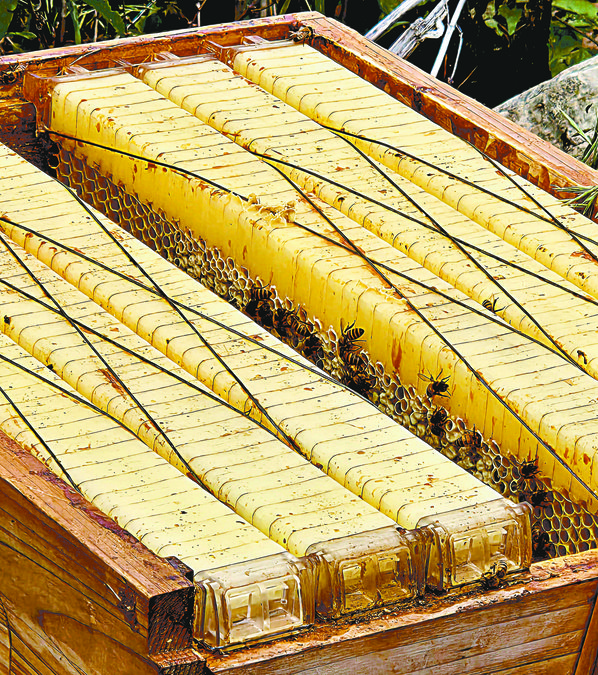
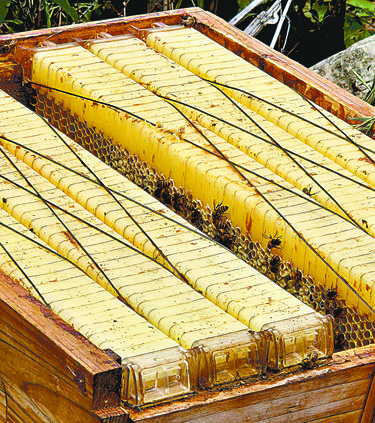
Many flow hives also offer a clear end frame that allows keepers to monitor the honey’s progress before harvesting.
Lyle and Ann demonstrated the key’s use, noting that it can take a while for the honey to come out depending on where the bees start to build honeycomb, the weather (heat makes honey flow better) and many other factors. It’s not a quick process — honey may not be as slow as molasses, but it’s not much faster, either.
“It’s like there are two pieces of plastic, and when you put that key in and move it apart, the honey drops out,” said Ann. “You don’t even disturb the bees, and the honey comes out.”
The club’s secretary, Dale Roeschley, added that flow hives may appeal to people who want to reduce the labor-intensive tasks associated with honey collection.
“You don’t have to have an extractor, you don’t have to cap, you don’t have to do a lot. Supposedly, it saves you a lot of work,” said Roeschley.
Flow hives were introduced approximately a decade ago in Australia, so they’re not exactly a brand-new piece of technological wizardry, but they aren’t common, especially in the United States. Part of the reason, according to Lyle, is the cost.
“It’s quite an investment compared to regular boxes, but on the other hand, if you buy the other ones, it’s not cheap either,” he said.
And he’s right: an entry-level Langstroth can still cost over $100, but a flow hive will likely make a much larger dent in an aspiring apiarist’s pockets — possibly several hundred dollars more.
In addition, Langstroths are more common, meaning it’s easier to find them, buy new parts when needed and get assistance when something needs to be fixed or figured out. It’s a bit like buying a fancy car from Europe: it’s all fun and chic until you need that tire rod that you can only import from a specialty company in Luxembourg.
Other detractors claim that flow hives can lead to lackadaisical beekeeping practices from apiarists who do not learn as much about the trade as they would with a standard hive.
Another common criticism levied against them is that flow hives are a gimmick.
But regardless of whether somebody wants a flow hive or a regular one, the Ridge and Valley Beekeepers Club wants to support experienced and new apiarists in southwest Wisconsin. To contact the group, check out their Facebook page.